Executive summary
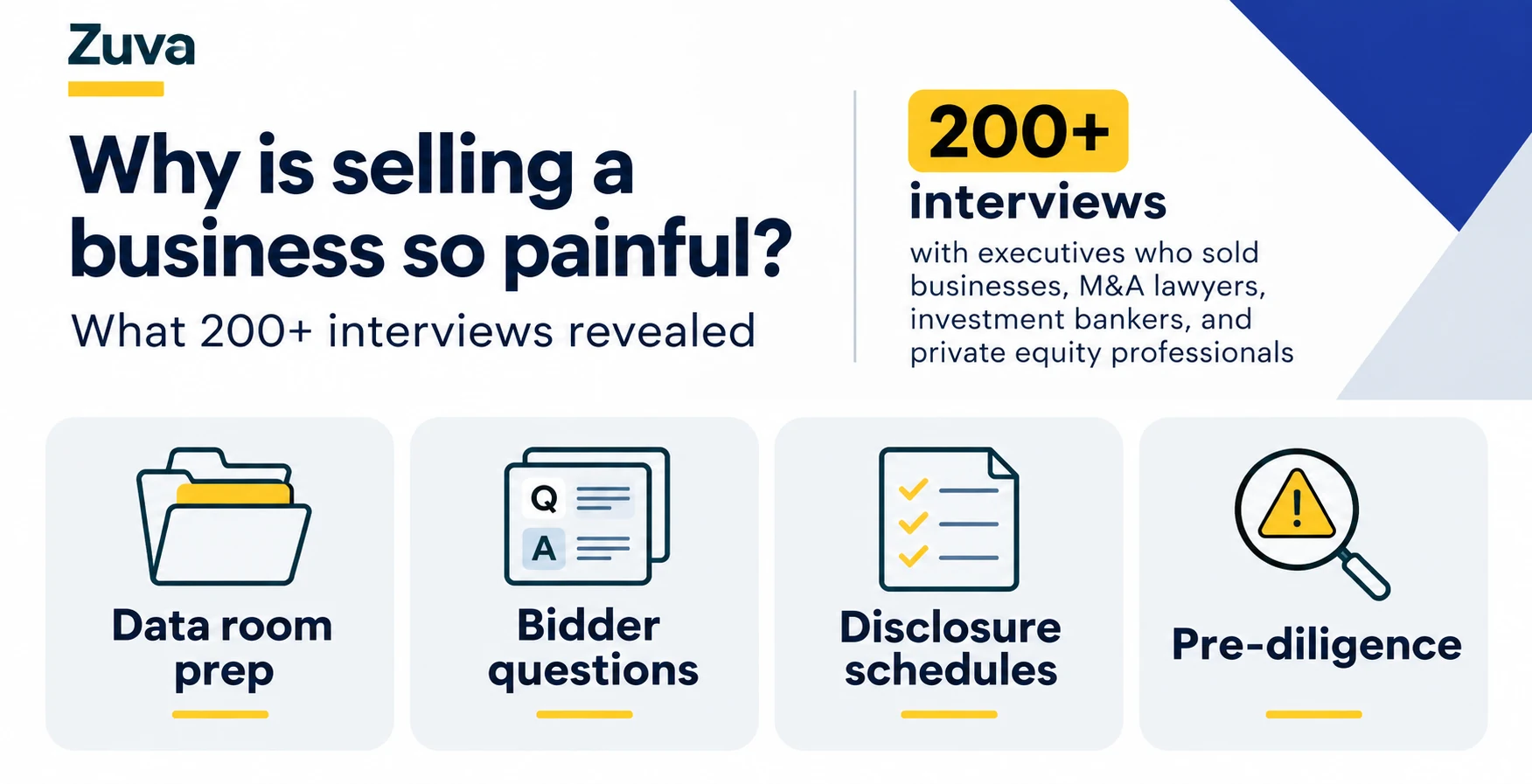
Over two years, Zuva interviewed more than 200 M&A people, mostly:
Executives at businesses that had sold (CEO, CFO, COO, GC, more)
M&A lawyers
Investment bankers
Private equity investors and legal teams
The conversations focused mainly on mid-market deals. The two questions were:
Is it a pain to sell a business?
What are the most painful parts?
The answer to the first was very consistently “yes!,” even when the deal went well. One otherwise mild-mannered COO described their experience as “fucking brutal.” A GC said, “It was the hardest thing I’ve ever had to do in my legal job.”
Four problems kept coming up
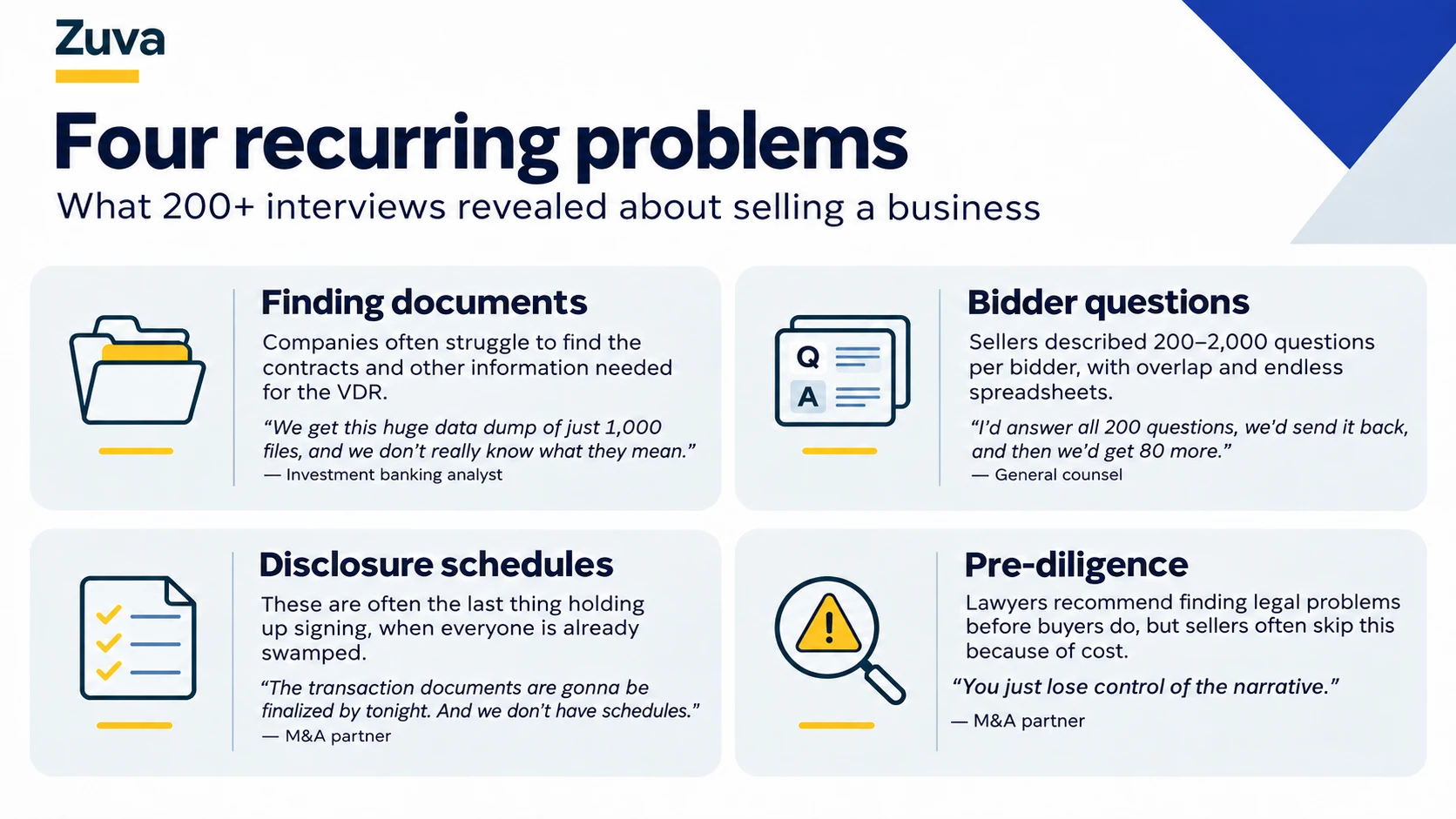
Finding documents and preparing the data room
Companies can struggle to find information to go in the VDR. Then someone (mostly i-bank analysts) has to organize, name, and redact everything.
“We get this huge data dump of just 1,000 files, and we don’t really know what they mean.” — Investment banking analyst
This generated the most complaints. Sellers described 200–2,000 questions per bidder, substantial overlap, and endless spreadsheets over email.
“I’d answer all 200 questions, we’d send it back, and then we’d get 80 more.” — GC
Preparing disclosure schedules
“Disclosure schedules are almost always the long pole in the tent when it comes to getting deals signed on time.” By this stage, companies generally have the documents they need. But finding the relevant information in them (e.g., identifying every contract requiring change-of-control consent or containing an MFN) can be a lot of work. So can assembling the more straightforward information, like lists of benefit plans, and putting everything into disclosure schedule format.
“The transaction documents are gonna be finalized by tonight. And we don’t have schedules.” — M&A partner
Lawyers recommend sellers do self-diligence, to find (and remediate) legal problems before buyers do. Sellers rarely do this, largely because of hesitancy to incur big costs ahead of getting bids. But they need to do this work anyways to prep disclosure schedules, and bidders discovering problems can be trouble.
“I had [a bidder uncover a contract issue the seller hadn’t caught] today. And last Friday. It’s really not good when the bidder knows more about the company’s contracts than you do.” — Investment banking VP
Two other notable findings
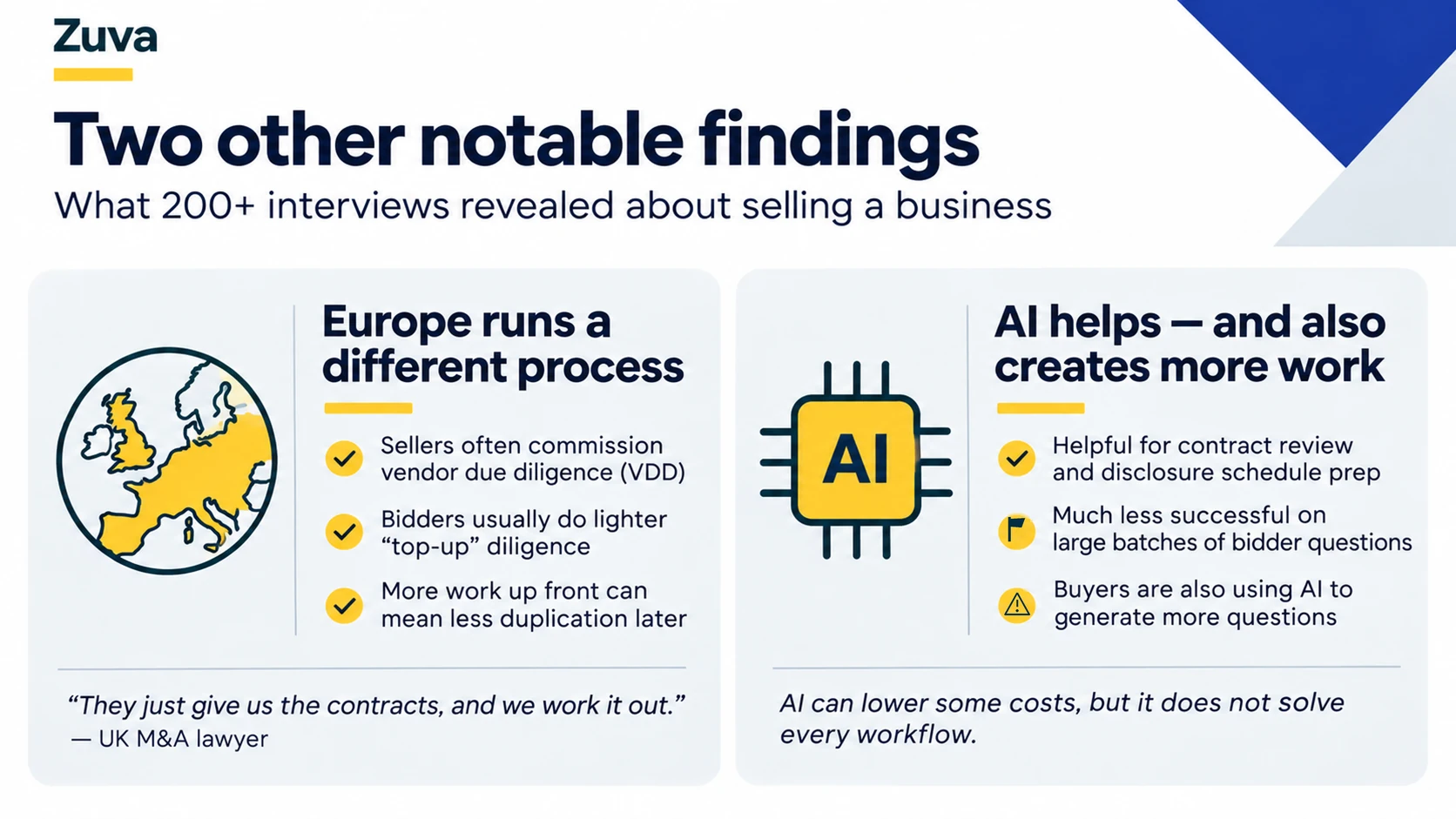
Europe runs a different process. In European auctions, sellers commonly commission vendor due diligence reports that bidders use for their own, more limited “top-up” diligence. Broader disclosure of data-room contents also reduces the need for detailed disclosure schedules. More work happens up front, with less duplication later.
AI helps with some of this, and also creates more work. AI paired with experienced reviewers can substantially reduce pre-diligence and disclosure-schedule-prep costs. Interviewees had much less success using AI to answer large batches of bidder questions. Some reported that buyers are using it to generate more questions instead.
Senior executive distraction can be even more costly than pricey M&A advisors
One GC spent about 90% of their time on a sale for nine months. CFOs, COOs, heads of HR, and CEOs can also get consumed by the deal. These are expensive people to have distracted from running the business.
The full report
In 2021, we sold Kira Systems for hundreds of millions of dollars. Selling felt like one of the hardest things our CFO and I have ever done professionally … and the next time will too. This despite the deal running pretty smoothly, in about 3.5 months from LOI to close.
We were reasonably prepared going into the deal. I had been a PE/M&A lawyer at Weil before starting Kira, then spent a decade building software heavily used on M&A deals. Our CFO started in audit and had led a bunch of deals in finance roles. As we built the business, we were pretty conscious about avoiding things that could cause issues in a deal. Nonetheless, we felt lots of pain (including actual pain from overwork-related injuries!).
A couple of years ago, we started wondering how common our experience was. Had other people found selling their businesses this hard? What had been especially painful? And could we help?
So we started asking. Over the last two years, we’ve interviewed over 200 people involved in M&A, mostly across four groups:
Executives at businesses that had sold: CEOs, CFOs, general counsels, and more (COO, head of HR).
M&A lawyers: nearly all partners, at firms in the US, Canada, the UK, and beyond.
Investment bankers: from analysts through group heads, at big banks and boutiques, in the US and Canada.
Private equity people: both deal teams and legal teams, at sponsors in the US, Canada, and the UK.
We also spoke with an assortment of other M&A professionals: tax and accounting advisors, quality of earnings providers, representations and warranties insurance underwriters and brokers, virtual data room personnel, and others. But those first four groups were the main focus.
Nearly all of our interviews were focused on “mid-market” businesses: ones selling from ~$50m to a few billion dollars. Mid-market sales seem like a perfect storm for sell-side pain: big enough businesses that there is real work and diligence involved in selling them, but with small enough teams that senior executives (CFO, COO, GC) need to be intimately involved in executing these deals - they can’t just pass the details off to their reports, as they might at a bigger business.
We had two basic questions:
Is it a pain to sell a business?
If so, what are the most painful parts?
The answer to the first was pretty consistently yes. On the second, we kept hearing about the same four problems, from people in different roles, working on different-sized deals, in different places. The four recurring problems were:
- Finding documents and setting up the VDR
- Answering bidder questions
- Preparing disclosure schedules, and
- Pre-diligence.
Selling a business is hard and takes over your job
One GC described their company’s sale this way:
“It was the hardest thing I’ve ever had to do in my legal job.”
The same GC estimated that they spent about 90% of their time on the sale for nine months. They described regular 70-hour weeks, with one reaching 108 hours.
One (otherwise mild-mannered-seeming) COO described their process as “fucking brutal.”
One law firm M&A partner put the staffing problem well: “You end up relying on the CFO to do everything. But the CFO is already doing everything anyway.” The CFO and GC can become so absorbed in selling the company that they have very little time left for their normal work. Meanwhile, the business still needs running.
There is also a limit to how much of this work you can delegate. A sale is confidential. Often only a small group inside the company are “in the tent” and know it’s happening. And a lot of the questions need answers from people who really understand the business.
So a relatively small number of senior people end up doing a huge amount of work, on top of whatever they can still manage of their regular jobs.
The pain in some interviews was so visceral we thought there might be a market for a post-transaction therapy offering.
The four big pain points
The four recurring problems we heard about most often. View full-size image
Finding the documents and getting the data room ready
Before buyers can review your company, you have to find the stuff they’re going to review.
This sounds pretty straightforward. In practice, the documents can be scattered around the business, and finding the fully executed and current version can be tricky. A person who would know where to look may not be in the tent.
The company generally has to do the finding. Bankers can give a request list and follow up, but they can’t magically know where documents are. We heard about deals getting off to a slow start because locating the materials took real time.
A UK M&A lawyer put it simply: “Most companies are not in sales shape.” They had seen this even at a company that had gone through another transaction only a few years earlier. A PE investor described one portfolio company taking three months to get its data room ready, despite bringing in somebody full time to help.
Then there is the work of turning what the company finds into a usable virtual data room (VDR). Investment banking analysts often take on organizing, naming, and redacting the documents. One described their starting point:
“We get this huge data dump of just 1,000 files, and we don’t really know what they mean.”
Getting the files is progress. But someone still has to figure out what they are, where they belong, and what can be shared with whom. As the analysts know, their job is pain.
Redaction can be particularly tedious. One analyst described tax records over 1,000 pages long that needed manual review for personal information. A PE investor pointed to a different problem: after anonymizing customer contracts, “customer 1” still has to be the same customer in the financial spreadsheet. Redacting the name is only part of what needs to be done.
VDR setup keeps going. A banking associate described an ongoing process of reviewing and reorganizing documents as more information arrives, rather than a one-time exercise before launch.
This is a good reason to get your documents in order before there is a deal. It’s easier to ask people around the company to help when you’re not also trying to keep a sale confidential. Once the deal is underway, the number of people available to help may be much smaller.
Not everyone found this part painful. One founder said the document work hadn’t been particularly hard because the company had been organizing its records consistently for years.
AI: especially good at organizing the VDR, less reliable at finding and redacting
Finding the documents in the first place is probably the hardest part for AI to help with. If a company has a good document management system, AI may be able to find what it needs. But if agreements are scattered across inboxes, shared drives, and employees’ computers, it’s a different story. One AI-pilled law firm M&A partner we spoke with made exactly this distinction: AI could be quite helpful at a well-organized company, but much less so when the documents are a mess.
Once the documents have been collected, AI is better suited to the work. It can help figure out what each document is, put it in the right VDR folder, give it a sensible name, and identify information that should be redacted. VDR organization is also somewhat subjective, and getting a document into the wrong folder usually isn’t a disaster (as long as that doesn’t mean sharing information with people who shouldn’t see it).
Redaction is different. It’s an example of how, in M&A, 80% accuracy isn’t good enough. A single missed redaction could expose commercially sensitive information to a bidder, potentially including a competitor. One banker told us that automated redaction tools built into VDR platforms were getting better, but weren’t yet fully reliable. AI can help with the work, but someone still needs to check it carefully. Getting 99 things right doesn’t necessarily make up for the one you got wrong.
Answering bidder questions over and over
Answering bidder questions was the part we heard the most pain around (mostly from companies, bankers, and PE investors; less from outside counsel).
People described getting 200–2,000 questions per bidder. An auction deal can have three (sometimes more) bidders, so this can really add up. One banker described seven buyers each sending 200 questions at a time. Their analysts and associates were cutting and pasting the requests into spreadsheets and tracking which ones were open, partly answered, or done.
As one GC put it:
“I’d answer all 200 questions, we’d send it back, and then we’d get 80 more.”
A bunch of the questions overlap. Bidders tend to be similar to each other, and they ask similar questions about the same business. Different advisors (e.g., legal, tax, accounting) working for the same bidder ask about the same things, without coordinating their questions. One banker described the finance and legal teams asking essentially the same questions about revenue by country. An answer sent to one team didn’t necessarily reach the other. So the question came back.
But similar doesn’t always mean identical. A senior banker pushed back on the idea that every repeated question could just be eliminated:
“When sellers are telling you, ‘We got asked the same thing 10 times,’ that’s not true. They got asked the similar thing 10 different ways.”
An earlier answer might get most of the way there, but this bidder may be asking for something slightly different. Someone has to notice that and fill the gap.
Starting from scratch every time wastes a lot of effort. Answering similar questions separately can also leave you with inconsistent answers.
Giving materially different answers to bidders can also create legal risk. A winning bidder might later argue it would have paid less if it had received information provided to a losing bidder.
Answering similar questions from the same bidder inconsistently creates commercial risk too, making the seller look as though it does not know what is happening or is not telling the truth.
Then there are questions that don’t need to be asked at all. When we brought up bidders asking for information already in the data room, one investment banking analyst replied, “I could go on for hours about that one.” They described spending months getting materials ready, only to receive a 200-question list from somebody who apparently hadn’t read them. Advisors frequently send over template questions, not bothering to tailor their questions to the target. Worse, different advisors often have similar template questions.
Going into the interviews, we assumed bankers pushed back on this. Sometimes they do. But another banker told us: “No, we never push back. We’re as assistive as possible.” The general North American banker view was that they (and the company) should do everything possible to assist bidders, so that they would make big bids.
Other bankers described screening questions and reusing approved responses so management didn’t have to answer again. We heard mixed feedback from sellers, though. One GC described telling the bankers something had already been answered, only to be asked where. The GC then had to go and find it themselves. Sellers who remembered answering duplicative questions tended to stay upset with their bankers, and would somewhat badmouth them.
One person who had been a lead M&A lawyer at a large, acquisitive strategic described a pretty uncompromising approach. Their legal diligence request list alone ran 30 pages. HR, finance, tax, ESG, and other groups had their own requests, adding up to “hundreds and hundreds of questions.” They even required sellers to organize their data rooms around the buyer’s questionnaire. And they pushed to get everything answered:
“N/A is not an answer. You don’t get to say not applicable. You tell us why.”
They acknowledged that this was “so much more painful for a seller,” but defended the approach. Their view was that asking fewer questions initially just delayed the inevitable. The attitude seemed to be, basically: We’re [company]. We’re paying a premium for your business. Deal with it.
Some questions need real thought from senior people at the company. Others can be answered by an investment banking analyst or associate looking in the data room. Sorting out which is which, and getting the right question to the right person, is itself work.
We kept hearing about spreadsheets over email as the main workflow here, at least in North America. Sometimes questions come in via email too. Many VDRs have Q&A features, but a lot of the people we spoke with weren’t using them. As one banker said, “We still send spreadsheets back and forth every day.”
The workflow is basically: a bidder sends a list. The bank works through what it can (including trying to answer questions that are similar to ones that were already answered), sends questions and draft answers to the company, collects answers, gets them reviewed, and sends a response back. Then another version arrives. Now, the bank has to figure out what changed, and then the cycle repeats.
One banking associate described sending a spreadsheet of bidder questions to the company, and sometimes hearing nothing for a week. “Have you been doing anything this week? We’re not necessarily sure.” The bank might start making updates itself, only to discover the company had been updating its own copy. Now someone had to combine them.
“Version control is an absolute nightmare sometimes with these.”
And not everything makes it into a spreadsheet. A GC described answers given on diligence calls that weren’t captured for people who hadn’t attended. They called the process a “huge communication information tracking black hole,” then reconsidered:
“Maybe it’s even worse than a black hole, because it’s not that things go in it and disappear. It’s that things go in it and metastasize into worse things.”
None of this means the buyers are wrong to ask questions. They’re considering spending a lot of money. They should understand what they’re buying. Some follow-up questions are necessary, and even a repetitive question can matter to the person asking it.
A rep & warranty insurance underwriter gave us the other side of this: “It’s 1,000 documents. I don’t even know where to look.” They said they did try to find the information themselves. Sometimes asking the question was simply easier.
But there is a lot of effort involved in keeping track of the questions and answers, quite apart from figuring out what the answers should be. That’s an especially frustrating use of time when the company has already provided the information somewhere else.
AI: more questions than answers (so far)
A bunch of bankers and PE people we spoke with had tried using AI to answer bidder questions. The approach was usually some version of: create a project or vault, put relevant documents into it (often the contents of the VDR), sometimes add previously answered bidder questions, then upload a new list of questions and ask the AI to answer them. We heard about attempts with frontier models, Copilot, and Rogo.
Sometimes this worked okay when there weren’t too many questions. Early in an auction, for example, there may be a lot of potential bidders, but each is only asking a page or two of questions. Or in a private credit financing, there may be a few prospective lenders, again with relatively short lists. We also heard of people using AI to help do an analysis needed to answer a particular question, rather than having it write the answer itself.
But for the main diligence Q&A process, the feedback was pretty consistently negative. Imagine uploading three spreadsheets of 200 questions each and getting back a spreadsheet with 600 proposed answers. The quality is all over the place. Now you have to figure out which answers are right, which need fixing, who needs to check them, and how to keep track of all that work. A spreadsheet full of AI answers isn’t much of a workflow. We met several people who’d tried this, but nobody who said they’d gotten it working well for the main diligence process, or who had kept using it after testing.
Meanwhile, more recently, we started hearing that AI was actually increasing the number of bidder questions. Buy-side teams are putting VDR documents into AI tools and having them generate diligence questions. Some of these questions are good. Others are nitpicky, or about things that experienced deal professionals wouldn’t consider important. One complaint we heard was that AI didn’t have a particularly good sense of what actually matters to a transaction, versus what just looks like it might be an issue. Either way, the questions land with the seller, who has to deal with them.
There’s an unfortunate asymmetry here. It’s increasingly easy for buyers to generate questions, but sellers still have to provide good answers. One PE GC, talking about answering prospective investor questions, put it this way: “They can’t take the risk of hallucination or wrong answers.” Incorrect answers can create liability, scare off bidders, or lead to a bunch more questions. And bidders really do read and rely on the answers. In our Kira sale, more than 100 people had access to the VDR, including substantial teams from EY and Skadden, looking closely at what we’d provided.
So, at least so far, AI seems to be creating more work for the sell-side without doing nearly as much to take the burden of answering questions off their hands.
Disclosure schedules: “the long pole in the tent”
Disclosure schedules provide detail about the business and identify exceptions to statements the seller makes in the acquisition agreement. By this point, companies generally have the underlying documents. But finding the relevant information in them, assembling lists of things like benefit plans, and putting everything into disclosure schedule format can take a lot of work.
Who actually does the work varies. At a number of very high-end law firms, we heard about selling companies doing nearly all of the first draft of disclosure schedules themselves, with the lawyers providing instructions and reviewing it. A partner at a top law firm explained why having the lawyers do more can get expensive: some of the work takes legal judgment, so you can’t just hand it all to first- or second-year associates. “You really have to have more senior resources, and then it gets preposterously expensive.” At some more mid-market firms, the outside lawyers did much more of the actual work. But even when outside counsel takes the lead, the company still has to supply information that only its people know.
A PE investor called disclosure schedule prep a “massive, massive lift.” They described managers saying all their contracts were standard, only to discover exceptions as the underlying documents were reviewed.
Most disclosure schedule prep work, maybe 80%, is pretty straightforward. List the company’s trademarks, its websites, its employees earning over a certain amount. But the other 20% can be really hard. For example, the schedules might require a list of every contract containing an exclusivity, non-compete, or MFN provision, and every contract over a certain dollar threshold that is terminable or requires consent on change of control. Unless someone has already gone through your contracts looking for those things (which you may not track in your contract management system, since they may not have everyday implications), you probably don’t know which ones qualify. Finding out takes a bunch of work, just when the CFO and GC are already swamped with the rest of the deal.
Then, even once you’ve figured out what needs to be disclosed, you have to put the results into “disclosure schedule format.” Contracts, for example, are often listed as “[Agreement Title], dated as of [Month Day, Year], [by and] between [Party A] and [Party B].” This is generally straightforward. But doing it for hundreds of contracts is tedious, and the work often gets passed to expensive law firm associates because people in the tent at the selling company are already overwhelmed. One PE GC described a lot of disclosure schedule preparation as “word processing” and estimated that it could take 50–100 hours and cost $50,000–$100,000. Another GC’s description:
“Turning your diligence into disclosure schedules is a nightmare.”
That GC, who had done a lot of deals in-house, said he tried to get law firms to break their bills down by task. But even then, the cost could be a surprise that only became clear when the deal was over: “By the time I find out … I just spent $75,000 on disclosure schedules. It’s kind of too late. It’s too late because the deal’s done.”
Experienced bankers and PE people repeatedly described disclosure schedules as:
“the long pole in the tent”
Everything else may be ready to sign, but the schedules aren’t. We know this is our second distinct M&A tent analogy 😁
One law firm M&A partner was living through this while we spoke. He was representing the buyer of a PE-owned company, and everyone was trying to sign that day or the next. The transaction documents were almost finalized, but the seller still hadn’t delivered its schedules. Both sides had major law firms.
“The transaction documents are gonna be finalized by tonight. And we don’t have schedules.”
In fact, the seller’s lawyers had been having so much trouble getting the schedules from their own client that they asked the buyer’s lawyers to help. The partner recalled their request: “Can you just please contact the company directly to push them for the schedules? We’ve been trying for four days.”
When schedules aren’t ready, the scramble can be ugly. Management ends up working late into the night. An experienced GC described “some poor junior associate or team of junior associates” doing the work “at the 11th hour.” One experienced M&A lawyer described what happens when the company initially takes on the schedules but can’t finish them: “Ultimately, the company is unable, and they will turn to counsel, who will have to do it all over again for triple the price at the last second.” Oddly, the law firms don’t necessarily do well out of it either. The rush work is super-miserable, blows the budget, and then the client pushes back on the bill. The firm may end up having to do a big write-off.
And sometimes the last-minute work turns up something that wasn’t previously disclosed. One in-house M&A lawyer told us about a deal where an IP ownership problem surfaced in the schedules. The process paused for about three weeks while they sorted it out, and the deal nearly fell apart. “Anything could have shifted in that pause,” the lawyer said. By that point the seller is pretty invested in getting the deal done. Having a sale fall apart during diligence isn’t a great look, and a late surprise can give the buyer an opening to ask for concessions.
As we heard repeatedly: “Time kills deals.”
Sometimes the schedules are late because the company puts them off. But being organized doesn’t make all of the late work go away. The GC who worked a 108-hour week had actually prepared schedules while filling the data room. Buyers’ lawyers had praised the company’s preparation.
The scramble came later, when the buyer’s lawyers asked for additional disclosures at the same time as more diligence answers. The GC was working through those requests while the acquisition agreement was being finalized and signatures were being collected.
Some of that timing is hard to avoid. The representations in the acquisition agreement may still be changing, and the schedules have to respond to what the agreement actually says.
AI: big savings, but still needs checking
Disclosure schedule preparation seems like a pretty good use of AI, especially the contract-related parts. AI can help find contracts containing provisions that need to be disclosed, like exclusivity, non-competes, and change of control consent requirements. It can also extract information like contract dates, parties, and titles, and help put it into disclosure schedule format. Contract AI has been doing versions of this work for years.
One PE partner at a large, mid-market-focused US law firm told us her team routinely uses Kira for sell-side disclosure schedule preparation. Staff attorneys run the AI, work through its results, and help prepare the schedules. The deal lawyers then QC the work. She said this combination produces substantial cost savings for clients. This is consistent with our experience at Zuva, where we combine AI with experienced lawyers to do this kind of work at significantly lower cost.
But AI still makes plenty of mistakes. In one recent Zuva project, we used GPT-5.5 Pro to summarize about 50 customer contracts. The results looked great, until our lawyers checked them against the original agreements. GPT missed provisions, got some summaries wrong, and sometimes appeared to simply make things up. This was buy-side diligence summarization rather than disclosure schedule preparation, and we’ve seen improvements in GPT’s contract review capabilities since then. But it illustrates a problem that remains important: AI work product can look right even when it isn’t.
The lesson isn’t to avoid using AI. Despite all those mistakes, it saved us a lot of time on that project, even accounting for the checking. The key is to use AI as a supplement, with experienced people reviewing the results, catching mistakes, and making the judgments AI isn’t reliably equipped to make. And it’s not enough to check what AI found; you also need to make sure it didn’t miss something that should have been disclosed.
Having the contracts already collected and the legal diligence done in advance gives you a much better starting point for the final rush to signing. But in North America, companies rarely do pre-diligence. The main reason we heard was cost.
Pre-diligence: everyone recommends it, few sellers do it
M&A lawyers we spoke to generally advised sellers to do legal diligence before bidders got into the data room. Understand the issues in your own business before the buyers find them. In North America, though, companies rarely do this.
If you discover an issue early, you may have time to fix it. Even if you can’t fix it, you and your advisors can figure out how to deal with it. If the buyer discovers it first, things can get much more difficult.
An investment banking VP told us he almost never sees sellers doing pre-diligence. When I asked whether bidders ever discover contract issues that the seller or its advisors didn’t know about, he replied:
“I had that today. And last Friday. It’s really not good when the bidder knows more about the company’s contracts than you do.”
One CEO described a deal that was delayed for three months because of an old non-compete. Resolving it required the large strategic buyer negotiating an agreement with the non-compete counterparty (another large company).
One of the biggest risks is getting surprised by something after you’ve already selected a buyer. Glenn West, described by Chambers as “one of the most influential M&A lawyers in the country,” said the biggest risk was “being surprised by something that you, the seller, didn’t know about.” He made a particularly good point about auctions. If you discover a problem before choosing a buyer, you can see how multiple bidders react to it. Different buyers may assess the risk differently, and you can take that into account when selecting a winner. But if the problem comes up after you’ve picked a buyer, you’ve lost that competitive tension. The buyer may now ask for a lower price, special indemnities, or other concessions, and you’ve got much less leverage.
Chris Machera, former co-head of Weil’s private equity practice, described a related problem: “You just lose control of the narrative.” If you know about an issue in advance, you can think through how to disclose it, coordinate with your bankers, and decide how to address it in the purchase agreement. That’s a lot harder when the buyer finds it first. Another senior M&A lawyer we interviewed put it this way: “You’re just giving the buyer reasons to come back and cut price, or otherwise change things.”
And finding unexpected problems can undermine the buyer’s confidence in the seller more generally. Wilson Chu, who advised Tesla’s special committee on Elon Musk’s $1 trillion pay package, explained: “It really lowers my confidence in what you are giving me.” His response would be to come back with “more robust reps, more robust requests.” So even a problem that turns out to be manageable can lead to a lot more work.
(Nearly everyone we interviewed is quoted anonymously in this article. We’re naming Glenn, Chris, and Wilson because we also produced a four minute video with them discussing the risks of skipping sell-side diligence. You can watch it here.)
One lawyer who led M&A legal work for a regular acquirer described their standard message to targets: “Tell me the things now, so I can help you later.” An issue they could work through early could become a much bigger problem if it only emerged just before signing.
Given all this, why don’t sellers do pre-diligence?
Mostly, cost. A pre-sale legal review by a high-end law firm can run $500,000, plus or minus a couple hundred thousand. That’s a lot to spend before knowing whether someone will make an acceptable offer for the company. You can spend a fortune preparing for a sale and still not sell.
The reluctance makes sense. But skipping pre-diligence doesn’t make the issues go away. Some of the same work will eventually have to be done for disclosure schedules anyway, only later, when everyone is already busy and there’s less time to deal with surprises.
AI: reducing the cost so pre-diligence actually happens
This is another area where AI could make a big difference, and in a slightly different way from the other tasks we’ve discussed.
AI can help review contracts for provisions that could cause problems in a sale, like change of control consent requirements, exclusivity, non-competes, and unusual termination rights. Experienced lawyers can then review the results, identify significant risks, and help the seller figure out what to do about them.
As we discussed in the disclosure schedules section, AI still makes mistakes. You can’t just run a pile of contracts through an AI system, accept whatever it tells you, and consider your diligence done. Lawyers still need to check the work, including looking for things the AI may have missed. And some important business issues aren’t going to be found in contracts at all.
But our experience at Zuva has been that combining AI with experienced lawyers can substantially reduce the cost of these reviews. There’s still plenty of human work involved, but much less time needs to be spent on the mechanical parts of reviewing hundreds of agreements.
This could be especially significant for pre-diligence. With disclosure schedules, AI can make work that needs to get done anyway much cheaper. With pre-diligence, reducing the cost may mean the work gets done at all.
If the choice is between spending hundreds of thousands of dollars on a traditional law firm review or skipping it, plenty of sellers will skip it. If they can get a reliable, lawyer-reviewed assessment for a fraction of that cost, the calculation changes.
And finding an issue while you’re still preparing to sell is usually a lot better than hearing about it for the first time from the buyer you’ve just picked.
Europe and North America do M&A differently
Two additional findings: European deal processes and AI’s mixed results. View full-size image
One of the more interesting things we learned was how differently deals are run in North America versus Europe (both the UK and continental Europe; Australian deals also tend to follow the UK approach).
In a number of ways, North American deals are harder on the seller, especially once the buyer’s diligence gets underway. European processes tend to involve more work up front, but less work once bidders get involved.
The biggest difference is probably vendor due diligence (VDD). In a European auction, particularly one involving private equity, it’s common for the selling company to hire a law firm to conduct legal diligence on itself before the bidders get involved. The lawyers review contracts and other documents, identify issues, and prepare a formal report. There are often similar reports from financial, tax, commercial, and other advisors.
This is a big undertaking. The legal VDD report alone can cost hundreds of thousands to millions of dollars. And the company still has to find the documents and answer questions from its own lawyers. One UK lawyer explained that management “have been put through the wringer by us before they have to be put through the wringer by a buyer.”
But there’s a big payoff. Instead of having three or four bidders each send their lawyers to conduct a full diligence review, the bidders all get the same VDD report. They can do their own diligence, and usually will, but much of it is more limited “top-up” diligence focused on issues in the report, gaps in its coverage, or things particularly important to that buyer.
The reports are initially distributed without the bidders having legal reliance on them. But the winning bidder can then pay to get reliance, often covering the entire law firm cost of producing the report. This means the buyer can have a claim against the report’s authors if something turns out to be wrong, subject to limitations.
VDD is a bit like the seller-commissioned quality of earnings (QofE) reports that are common on North American deals, but extending the concept to legal and other diligence.
This seems like a much more sensible way to run an auction. You do a substantial amount of the work once, rather than having multiple bidders pay their own lawyers to do essentially the same thing. The seller also finds out about problems before the bidders do, with time to potentially fix them or at least think through how to handle them.
There’s another potential benefit of VDD: a higher sale price. Putting in a serious bid can be expensive, especially when there’s a good chance you won’t win. If a credible diligence report reduces those costs, more potential buyers may be prepared to participate, and their bids should be better informed. More serious competition could translate into a higher price for the seller. And better-informed bids should mean fewer surprises in later diligence, reducing the risk that the winning bidder tries to renegotiate the price.
VDD also changes the bidder question process. Lawyers we spoke with in the UK described bidders first directing questions to the lawyers who prepared the VDD report, often through calls with those lawyers. Only questions that they couldn’t answer would need to go back to the company.
There also seems to be a greater willingness to put limits on bidder questions in Europe. One UK lawyer described an auction where bidders were allowed 100 questions in total. Others had limits of 10 questions a day. Compare that to the North American banker we spoke with who said they never pushed back on bidder questions.
Another big difference is disclosure schedules. In North America, the selling company is typically expected to identify exceptions to its representations and warranties in detailed disclosure schedules. As we’ve discussed, that can be a huge amount of work, often happening very late in the deal.
In European deals, it’s more common to generally disclose the contents of the VDR by reference. A UK lawyer explained that, subject to the agreed disclosure standard, “anything we’ve given you in the data room is taken to be disclosed.” There can still be specific disclosures, but the seller doesn’t necessarily have to produce the same exhaustive schedules identifying every contract with a change of control clause, every exception to a representation, and so on. When specific disclosures are needed, the lawyers may do much of the contract review themselves. As one UK M&A lawyer put it, “They just give us the contracts, and we work it out.” That’s a pretty significant reduction in work for the GC and their team.
Melissa Sawyer, Sullivan & Cromwell’s global co-head of M&A, recently published a piece bluntly titled “Disclosure Schedules are a Waste of Money.” Writing about US public-company deals, she argues that disclosure schedules largely duplicate information already available to buyers, consume enormous amounts of time and money, and delay signing. Among her suggestions is doing what many non-US deals already do: incorporating the VDR by reference. She’s focused on public-company transactions, but many of her complaints will sound familiar to anyone who’s prepared disclosure schedules on a private deal.
None of this means European sellers have it easy. Preparing the VDD report can be extremely expensive and a lot of work. Buyers don’t always accept the report’s scope, and some conduct substantial additional diligence anyway. Bidder questions can still get out of hand. And not every European deal follows this process, particularly smaller transactions, bilateral deals, or deals on compressed timelines. Some North American deals also involve sell-side diligence.
But the general contrast is pretty striking. North American processes often leave sellers dealing with large volumes of bidder questions and detailed disclosure schedules late in the transaction. European processes more often get much of that work done in advance, with the advisors taking on more of the burden.
The European approach involves more work and expense up front, but can avoid a lot of duplicated work and give the seller a much better chance of controlling the process. Market practices shift slowly, though, and we’re not holding our breath waiting for the North American M&A market to adopt it.
What it all comes down to
One of the most important parts of buying a business is knowing what you’re getting. And, in one way or another, that’s what all four pain points are about. Buyers need to understand the business and its risks. Sellers need to find and organize the information, answer questions about it, and disclose issues. Ideally, sellers understand the issues themselves before buyers discover them.
The amount of management time this can consume is remarkable. CFOs, GCs, COOs, heads of HR, and (sometimes) CEOs can become almost entirely occupied with the deal (including diligence) for months. These are expensive people to have tied up, and their regular jobs don’t stop while the transaction is underway. Anything that enables them to spend more time focused on running the business has real value, beyond potential savings in the transaction budget.
There’s also a lot to be said for getting ahead of problems. Finding an issue early gives the seller a chance to fix it. And if it can’t be fixed, at least the seller can figure out how to explain it to bidders. That’s much better than having a buyer uncover a surprise late in the process, especially after the seller has selected a winning bidder.
How we’re trying to help at Zuva
These conversations shaped what we’re doing at Zuva.
AI-assisted diligence reviews
One part of that is pre-diligence contract review and disclosure schedule preparation. We combine AI with Biglaw-experienced lawyers to review contracts for provisions that matter in a deal, for around 80% less than high-end Biglaw firms would charge. The findings can then feed into the contracts-related sections of the disclosure schedules, working with the seller’s law firm. Radically lower costs make it much easier for sellers to justify doing pre-diligence before a sale is even underway. One pre-diligence customer, writing while in the middle of diligence, described our work as “extremely helpful.”
Legaltech Hub’s experience is a good example. In a published account of its pre-diligence review, the company described a project that took just “two or three hours of hands-on time” from its team and surfaced an issue well before any sale process. “Catching this when we did, with plenty of time to address it, is exactly why we ran the review early,” said Jeroen Plink, its COO.
Quality matters too. In a comparison against diligence from two completed Biglaw-led deals, Zuva’s AI and lawyer-reviewed findings were compared with the law firms’ original work. David Pashman, GC of JWX, concluded that Zuva “performed similarly to Biglaw (within the scope of the review) for a much lower cost and at a much faster pace.”
Somewhat unexpectedly, we’ve also been pulled into buy-side diligence. Our offering seems especially well-suited to auctions, where bidders need to review contracts thoroughly before putting in an offer but are reluctant to spend heavily on diligence for a deal they may not win.
Some of the referrals for this work have actually come from high-end Biglaw firms, whose clients could benefit from pre-diligence or disclosure schedule assistance but are unwilling to pay Biglaw rates for it.
Helping answer bidder questions
We’re also building bidder question answering software, currently in beta. It uses AI to triage questions, find documents that could help answer them, and surface similar questions and answers from earlier in the process. It also helps sellers and their bankers assign questions, track progress, and see what changed in updated request lists. People still review responses before sending them to bidders. The idea is to use AI where it helps, enhancing the quality of the answers, and to spend less time hunting through spreadsheets and repeating work that’s already been done.
Selling a business will probably always be a lot of work. There are big decisions to make, real issues to resolve, and a lot of money at stake. But there should be plenty of opportunities to make some of the more repetitive and time-consuming parts of the process less painful.
Please reach out if we can help
We love hearing sale stories. If you’ve been through a sale, we would love to hear about your experience. And if you’re getting ready for one, get in touch.
We’ve also presented these findings at law firm training sessions in several countries. The feedback has been quite positive: “Thought it went great. Was informative and entertaining. That’s hard to do!”, “It was a great presentation and well received. Lots of positive feedback.” and “It was great!” We’re happy to present elsewhere. Get in touch to discuss.
Interview quotations have been lightly edited for readability. Interviewees and identifying deal details are generally anonymous unless otherwise identified.
Thanks to Susan Fox, Aroshi Amarasinghe, François Longtin, and Dr. Adam Roegiest for participating in many of these interviews (directly and indirectly).


