Pre-Diligence & Disclosure Schedule Prep
We read your contracts before your buyers do. We find the provisions that matter in a deal and turn those findings into disclosure-schedule-ready output. Experienced lawyers. Purpose-built AI. About 80% less than what a good Biglaw firm charges.
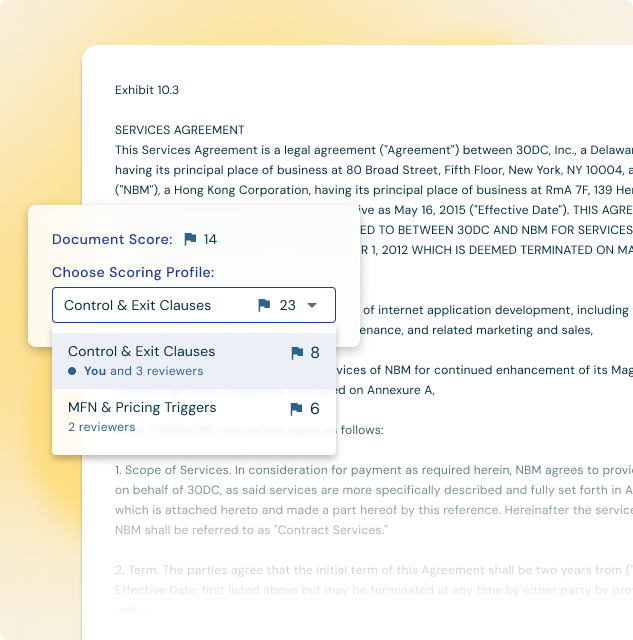
Tech-Enabled Services
We use AI-powered, Biglaw-experienced lawyers to offer a range of legal diligence help for sell-side deals. Scope is always tailored to what your deal needs.
Active agreement confirmation
Identifying which of your agreements are fully executed, partially signed, unsigned, or draft. We can also try to determine which are still in force, to the extent that can be determined from the agreement itself. Useful early in the process, before loading the VDR.
Red-flags review
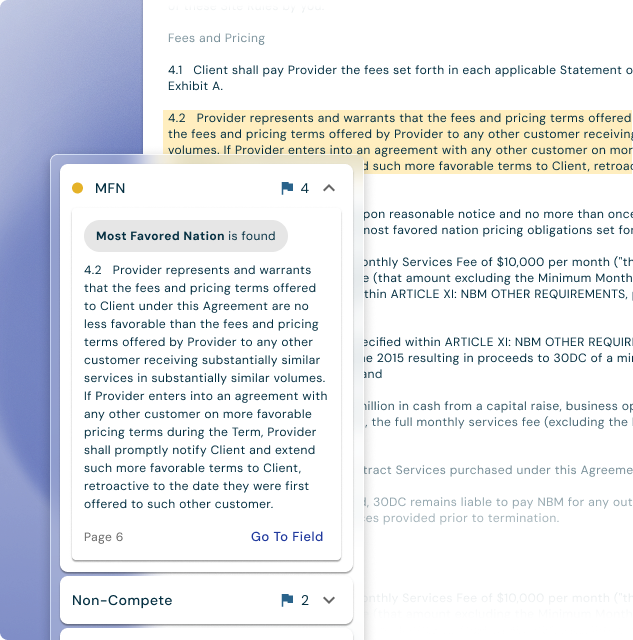
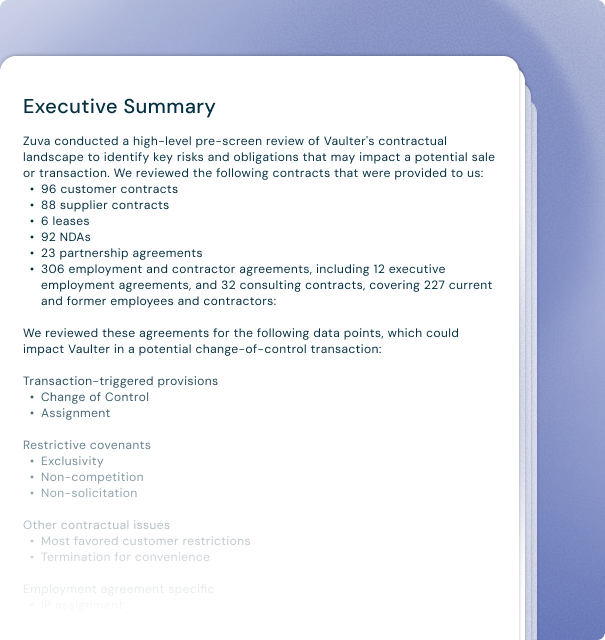
We review your contracts (customer, supplier, partner, NDA, employment/contractor, lease) for the provisions buyers' lawyers will focus on, like change of control consent and termination rights, restrictive covenants (exclusivity, non-competes, non-solicitation), and MFN. Output can be an Excel summary, a diligence-memo style report, disclosure schedule format, or something custom.
Because our offering is reasonably priced, you can have us review everything, not just the few largest contracts. In our experience, big problems can lurk in small agreements.
Disclosure schedule preparation
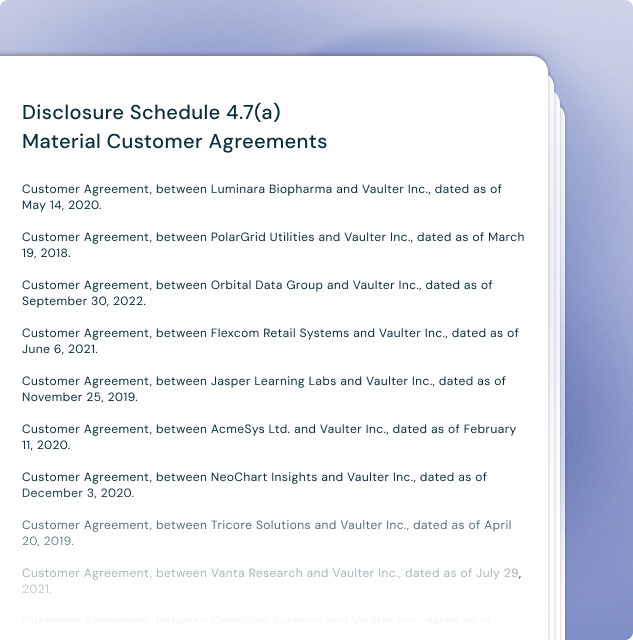
We prepare the contracts-related sections of your disclosure schedules, using our pre-diligence findings as the foundation. Typically, we do these in coordination with your law firm, and once reps are closer to being set. We take an overinclusive approach: it's easier to cut back than to add later.
The optimal sequence: pre-diligence review as early as possible (to find problems while there's still time to remediate), then disclosure schedule prep closer to signing as reps are finalized.
Employment agreement IP review
Reviewing employment and contractor agreements for IP assignment language, and grouping them into families. Most relevant for IP-creating employees and contractors (developers, designers, product managers, content creators) at IP-driven businesses. Often a starting point for further review by specialist employment counsel.
Employee benefit plan cataloging
Identifying formal benefit plans from the VDR, or more broadly, identifying benefits referenced across employment agreements, offer letters, handbooks, and board minutes. Output is a structured list that can serve as a starting point for the benefit plan disclosure schedule.
From contracts to disclosure-ready output
Pre-diligence findings feed directly into your disclosure schedules. Your lawyers do not need to start from scratch at $1,000/hr during closing crunch. The earlier you engage us, the more useful the output.
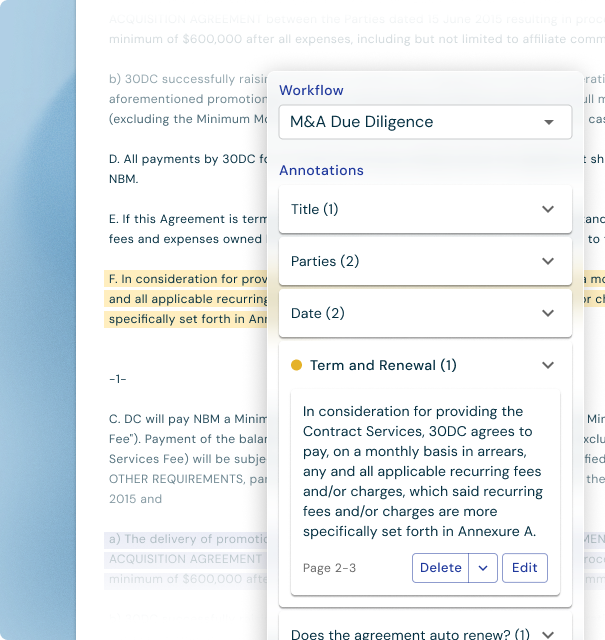
Contracts uploaded and review scoped
We load your contracts (or help you do it) and scope the review together: which contract types, what materiality thresholds, any deal-specific instructions from your lawyers.
AI extraction
Our AI (the same underlying technology most leading M&A law firms use for buy-side diligence) scans every document for deal-relevant provisions.
Lawyer review and contextualization
An experienced corporate lawyer contextualizes findings, flagging what's significant in deal context and applying judgment software alone cannot provide.
Pre-diligence report delivered
A home-inspection-style report: what we found, what's likely to matter, what might need attention. Written for you and your advisors.
Disclosure schedules prepared
Pre-diligence findings used to prepare the contracts-related sections of your disclosure schedules. Ready to hand off to counsel. Not a last-minute scramble.
“Disclosure schedules are almost always the long pole in the tent when it comes to getting deals signed on time.”
— Senior Private Equity InvestorRisks of skipping sell-side diligence
There are real risks of going into a sale process without knowing what's in your contracts.
- Sellers lose control of when and how issues are disclosed
- Buyer confidence drops; requests for reps and warranties become more aggressive
- Skipping diligence signals to buyers that the house is not in order
- Management unawareness of liabilities can create exposure to fraud claims
- Buyers reprice or demand special indemnities when they discover hidden liabilities
Four minutes. Three prominent M&A/PE lawyers. What to know about the risks of skipping sell-side diligence.
Does the work hold up?
We've had our output scrutinized by top M&A lawyers. Here's what happened.
Two Chambers Band 1 firms.
Zero additions.
Zuva prepared the contracts-related disclosure schedules on a recent PE-sponsored deal. Two Chambers Band 1 M&A firms were representing the parties. After our work was delivered, neither firm identified a single contractual item requiring disclosure that we had missed.
Case study available under NDA.
Contact UsSide-by-side vs. Biglaw.
Comparable results.
We obtained access to the VDRs from two completed Biglaw-led deals. We produced our own reports independently, without seeing the Biglaw work, and compared them side-by-side with a GC with two decades of M&A experience. The results were very similar within the scope reviewed.
"Zuva performed similarly to Biglaw (within the scope of the review) for a much lower cost and at a much faster pace."
— David Pashman, General Counsel, JWX
Read the case study“We are always looking for ways to reduce the burden on our portfolio company executives during a sale process. Zuva helped us do that and saved us money as well. We’ll use them again.”
— Jim Miller, Partner and General Counsel, Clairvest* Based on a recent client case study (details available under NDA).
About 80% less than what a good Biglaw firm charges
High-end Biglaw firms typically charge $300,000–$700,000 for sell-side legal diligence work. A smaller firm might be closer to $100,000. Both will typically limit their review to a narrow set of "material" contracts. Many sellers skip it entirely due to high costs before solid bids are in, which means buyers are often the first to find the problems.
Pricing varies by services required, number of documents, output format, and speed. Full pricing details
Save significant management time on disclosure schedule prep
In a recent deal, client management time on this was cut by more than 50%.
Surface contract issues before buyers find them
Find one issue early and it can be worth far more than the cost of the review.
Reduce law firm fees on disclosure schedule prep
Zuva does this work upfront at ~80% less than a good law firm, so your lawyers' involvement at the closing crunch is much lighter.
Common questions
What happens if Zuva misses something?
Even though we've come out reasonably well in accuracy tests against good Biglaw firms, we may miss things. (So do they.) Here's why that's manageable.
For pre-screens, the status quo is usually to skip pre-diligence entirely because law firms are so expensive. Missing something is not ideal, but you miss everything if you don't do the review at all.
For disclosure schedules, in US and Canadian deals, liability for disclosure errors tends to sit with the buyer, especially if there's reps & warranties insurance on the deal (which has become typical in mid-market transactions). So the buyer should be thoroughly diligencing and proposing revisions to disclosure schedules for anything that was missed.
How much effort does a review require from the seller?
Very little. There are three things the seller's team needs to do:
- Scope the project. The seller's management (or their outside lawyer) helps us scope the review, which typically takes a 30-minute call.
- Provide the documents.
The seller provides us with the documents to review, which can
take some work for administrative people to track down.
- If you're planning a deal, you'll need to gather these documents anyway. There are real benefits to doing it early. Documents are sometimes harder to find than expected, which can slow a deal down if you haven't already collected them.
- When a deal gets serious, sellers tend to strictly limit who knows about it. (A typical "tent" might cover around 10% of the company.) That can make it hard to enlist the right people to help locate documents. If you start early, before there's a tent, it's easier to get the relevant revenue ops person (or equivalent) to dig out the right files.
- Review the report and remediate. The seller reviews our report and remediates any problems we flag. Reviewing the report is fast, and remediation (if needed) is time very well spent.
When is the best time to do a review?
Ideally, a bit more than a year before a deal. The earlier you start, the more time you have to remediate problems we find. Starting more than a year out lets you address contract issues as agreements come up for renewal, which is the least awkward time to renegotiate terms. That said, we also get called in to do pre-diligence reviews right before bidders hit the VDR, or to prepare disclosure schedules while bidders are already in it.